วันอาทิตย์ที่ 16 กันยายน พ.ศ. 2555
Waffle
A waffle is a batter-based or dough-based cake cooked in a waffle iron patterned to give a characteristic size, shape and surface impression. There are many variations based on the type of iron and recipe used, with over a dozen regional varieties in Belgium alone.
Waffles are eaten throughout the world, particularly in Belgium, France, Netherlands, and the United States.
Etymologies
The word “waffle” first appears in the English language in 1725: "Waffles. Take flower, cream..." It is directly derived from the Dutch ‘’wafel’’, which itself derives from the Middle Dutch ‘’wafele’’.
While the Middle Dutch ‘’wafele’’ is first attested to at the end of the 13th century, it is preceded by the French ‘’walfre’’ in 1185; both are considered to share the same Frankish etymological root ‘’wafla’’. Depending on the context of the use of ‘’wafla’’, it either means honeycomb or cake.
Alternate spellings throughout contemporary and medieval Europe include wafre, wafer, wâfel, waufre, gaufre, goffre, gauffre, wafe, waffel, wåfe, wāfel, wafe, vaffel, and våffla.
History
Medieval origins
Waffles are preceded, in the early Middle Ages, around the period of the 9th-10th centuries, with the simultaneous emergence of fer à hosties / hostieijzers (communion wafer irons) and moule à oublies (wafer irons). While the communion wafer irons typically depicted imagery of Jesus and his crucifixion, the moule à oublies featured more trivial Biblical scenes or simple, emblematic designs. The format of the iron itself was almost always round and considerably larger than those used for communion.
The oublie was, in its basic form, composed only of grain flour and water – just as was the communion wafer. It took until the 11th century, as a product of The Crusades bringing new culinary ingredients to Western Europe, for flavorings such as orange blossom water to be added to the oublies; however, locally-sourced honey and other flavorings may have already been in use before that time.
Oublies, not formally named as such until ca. 1200, spread throughout northwestern continental Europe, eventually leading to the formation of the oublieurs guild in 1270. These oublieurs/obloyers were responsible for not only producing the oublies but also for a number of other contemporaneous and subsequent pâtisseries légères (light pastries), including the waffles that were soon to arise.
14th-16th Centuries
It’s in the late 14th century that the first known waffle recipe is penned in an anonymous manuscript, Le Ménagier de Paris, written by a husband as a set of instructions to his young wife. While it technically contains four recipes, all are a variation of the first: Beat some eggs in a bowl, season with salt and add wine. Toss in some flour, and mix. Then fill, little by little, two irons at a time with as much of the paste as a slice of cheese is large. Then close the iron and cook both sides. If the dough does not detach easily from the iron, coat it first with a piece of cloth that has been soaked in oil or grease. The other three variations explain how cheese is to be placed in between two layers of batter, grated and mixed in to the batter, or left out, along with the eggs.
Though some have speculated that waffle irons first appear in the 13th-14th centuries, it isn’t until 15th century that a true physical distinction between the oublie and the waffle (wafel / gaufre) begins to evolve. Notably, while recipes like the fourth in Le Ménagier de Paris is only flour, salt and wine – indistinguishable from common oublies recipes of the time – what does emerge is a new shape to many of the irons being produced. Not only are the newly-fashioned ones rectangular, taking the form of the fer à hosties, but some circular oublie irons are cut down to create rectangles. It’s also in this period that the waffle’s classic grid motif appears clearly in at least one known fer à oublie – albeit in a more shallowly engraved fashion – setting the stage for the more deeply gridded irons the Dutch were about to introduce.
By the 16th century, paintings by Joachim de Beuckelaer, Pieter Aertsen and Pieter Bruegel clearly depict the modern waffle form. Bruegel’s work, in particular, not only shows waffles being cooked, but also features a man wearing three waffles strapped to his head, playing dice for waffles with a black-masked carnival-goer. The detail of this section is so fine that the waffle pattern can be counted as a large 12x7 grid, with cleanly squared sides, suggesting the use of a fairly thin batter, akin to our contemporary Brussels waffles (Brusselse wafels).
Earliest of the 16th century waffle recipes, Om ghode waffellen te backen – from the Dutch KANTL 15 manuscript (ca. 1500-1560) – is only the second known waffle recipe after the four variants described in Le Ménagier de Paris. For the first time, partial measurements are given, sugar is used, and we see spices being added directly to the batter: Take grated white bread. Take with that the yolk of an egg and a spoonful of pot sugar or powdered sugar. Take with that half water and half wine, and ginger and cinnamon.
Alternately attriibuted to the 16th and 17th centuries, Groote Wafelen from the Belgian Een Antwerps kookboek is published as the first recipe to use leavening (beer yeast): 'Take white flour, warm cream, fresh melted butter, yeast, and mix together until the flour is no longer visible. Then add ten or twelve egg yolks. Those who do not want them to be too expensive may also add the egg white and just milk. Put the resulting dough at the fireplace for four hours to let it rise better before baking it. Until this time, no recipes contain leavening and can therefore be easily cooked in the thin moule à oublies. Groote Wafelen, in its use of leavening, implies the need for the deeper irons (wafelijzers) depicted in the Beuckelaer and Bruegel paintings of the time.
วันพฤหัสบดีที่ 6 กันยายน พ.ศ. 2555
Bucharest
Bucharest (Romanian: București pronounced [bukuˈreʃtʲ] ( listen); names in other languages) is the capital municipality, cultural, industrial, and financial centre of Romania. It is the largest city in Romania, located in the southeast of the country, at 44°25′57″N 26°06′14″ECoordinates: 44°25′57″N 26°06′14″E, and lies on the banks of the Dâmbovița River.
Bucharest was first mentioned in documents as early as 1459. Since then it has gone through a variety of changes, becoming the state capital of Romania in 1862 and steadily consolidating its position as the centre of the Romanian mass media, culture and arts. Its eclectic architecture is a mix of historical (neo-classical), interbellum (Bauhaus and Art Deco), Communist-era and modern. In the period between the two World Wars, the city's elegant architecture and the sophistication of its elite earned Bucharest the nickname of "Little Paris" (Micul Paris). Although many buildings and districts in the historic centre were damaged or destroyed by war, earthquakes, and Nicolae Ceaușescu's program of systematization, many survived. In recent years, the city has been experiencing an economic and cultural boom.
According to provisional data from 2011 census, 1,677,985 inhabitants live within the city limits, a decrease from the figure recorded at the 2002 census. The urban area extends beyond the limits of Bucharest proper and has a population of 1.93 million people. Adding the satellite towns around the urban area, the proposed metropolitan area of Bucharest would have a population of 2.2 million people. According to Eurostat, Bucharest has a Larger Urban Zone of 2,151,880 residents. According to unofficial data, the population is more than 3 million. Bucharest is the 10th largest city in the European Union by population within city limits.
Economically, Bucharest is the most prosperous city in Romania and is one of the main industrial centres and transportation hubs of Eastern Europe. The city has a broad range of convention facilities, educational facilities, cultural venues, shopping arcades, and recreational areas.
The city proper is administratively known as the Municipality of Bucharest (Municipiul București), and has the same administrative level as a county, being further subdivided into six sectors.
Etymology
The name of Bucureşti has an uncertain origin: tradition connects the founding of Bucharest with the name of Bucur who was either a prince, an outlaw, a fisherman, a shepherd, or a hunter, according to different legends. In Romanian the word stem bucur means 'joy', ("beautiful") and it is believed to be of Dacian origin.
There were various other etymologies given by early scholars, including the one of Ottoman traveler Evliya Çelebi, who said that Bucharest is named after a certain "Ebu-Kariş", from the tribe of "Beni-Kureiş". In 1781, Franz Sulzer claimed that it's related to bucurie (joy), bucuros (joyful), a bucura (to become joyful), while an early 19th century book published in Vienna assumed its name is derived from "Bukovie", a beech forest.
The official city name in full is the "Municipality of Bucharest" (Romanian: Municipiul București).
A native or resident of Bucharest is called a "Bucharester" (Romanian: bucureștean).
History
Bucharest's history alternated periods of development and decline from the early settlements of the Antiquity and until its consolidation as capital of Romania late in the 19th century.
First mentioned as the "Citadel of București" in 1459, it became a residence of the Wallachian prince Vlad III the Impaler. Bucharest rapidly grew to be the economic center of Romania.
The Ottomans appointed Greek administrators to the town beginning in the 18th century. A revolt led by Tudor Vladimirescu in 1821 ended the rule of the Constantinople Greeks of the town.
The Old Princely Court (Curtea Veche) was built by Mircea Ciobanul, and under subsequent rulers, Bucharest was established as the summer residence of the court, competing with Târgoviște for the status of capital after an increase in the importance of southern Muntenia brought about by the demands of the suzerain power, the Ottoman Empire.
Bucharest became a permanent location for the Wallachian court after 1698 (starting with the reign of Constantin Brâncoveanu).
Partly destroyed by natural disasters and rebuilt several times during the following 200 years, and hit by Caragea's plague in 1813–1814, the city was wrested from Ottoman control and occupied at several intervals by the Habsburg Monarchy (1716, 1737, 1789) and Imperial Russia (three times between 1768 and 1806). It was placed under Russian administration between 1828 and the Crimean War, with an interlude during the Bucharest-centred 1848 Wallachian revolution, and an Austrian garrison took possession after the Russian departure (remaining in the city until March 1857). Additionally, on 23 March 1847, a fire consumed about 2,000 buildings, destroying a third of the city.
In 1862, after Wallachia and Moldavia were united to form the Principality of Romania, Bucharest became the new nation's capital; in 1881, it became the political centre of the newly-proclaimed Kingdom of Romania under Carol I. During the second half of the 19th century, due to its new status, the city's population increased dramatically, and a new period of urban development began. During this period, gas lighting, horse-drawn trams and limited electrification were introduced. The Dâmboviţa was also channelled in 1883, thus putting a stop to previously endemic floods. The extravagant architecture and cosmopolitan high culture of this period won Bucharest the nickname of "Little Paris" (Micul Paris), with Calea Victoriei as its Champs-Élysées.
Between 6 December 1916 and November 1918, the city was occupied by German forces as a result of the Battle of Bucharest, with the legitimate capital temporarily moved to Iași. After World War I, Bucharest became the capital of Greater Romania. The interwar years saw continued development, with the city gaining an average of 30,000 new residents each year. Also, some of the city's main landmarks were built in this period, including Arcul de Triumf and Palatul Telefoanelor. However, the Great Depression took its toll on Bucharest's citizens, culminating in the Griviţa Strike of 1933.
In January 1941, the city was the scene of the Legionnaires' rebellion and Bucharest pogrom. As the capital of an Axis country and a major transit point for Axis troops en route to the Eastern Front, Bucharest suffered heavy damage during World War II due to Allied bombings, and, on 23 August 1944, was the site of the royal coup which brought Romania into the Allied camp, suffering a short period of Luftwaffe bombings as well as a failed attempt by German troops to take the city by force.
After the establishment of communism in Romania, the city continued growing. New districts were constructed, most of them dominated by tower blocks. During Nicolae Ceaușescu's leadership (1965–1989), much of the historic part of the city was demolished and replaced with Socialist realist development such as the Centrul Civic (the Civic Centre), including the Palace of the Parliament, where an entire historic quarter was razed to make way for Ceaușescu's megalomaniac constructions. On 4 March 1977, an earthquake centered in Vrancea, about 135 km (83.89 mi) away, claimed 1,500 lives and caused further damage to the historic centre.
The Romanian Revolution of 1989 began with mass anti-Ceaușescu protests in Timișoara in December 1989 and continued in Bucharest, leading to the overthrow of the Communist regime. Dissatisfied with the post-revolutionary leadership of the National Salvation Front, student leagues and opposition groups organized large-scale protests continued in 1990 (the Golaniad), which were violently stopped by the miners of Valea Jiului (the Mineriad). Several other Mineriads followed, the results of which included a government change.
After the year 2000, due to the advent of significant economic growth in Romania, the city has modernized and is currently undergoing a period of urban renewal. Various residential and commercial developments are underway, particularly in the northern districts, while Bucharest's historic centre is currently undergoing restoration.
Treaties signed in Bucharest
Treaty of 28 May 1812, at the end of the Russo-Turkish War
Treaty of 3 March 1886, at the end of the Serbo-Bulgarian War
Treaty of 10 August 1913, at the end of the Second Balkan War
Treaty of 4 August 1916, the treaty of alliance between Romania and the Entente
Treaty of 6 May 1918, the treaty between Romania and the Central Powers
สนธิสัญญา maastricht
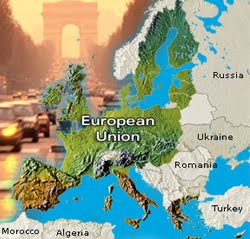
สหภาพยุโรป (European Union) หรือ อียู (EU) เป็นองค์กรระหว่างประเทศ ที่ประกอบไปด้วยรัฐต่างๆ ในยุโรปจำนวน 25 รัฐ ซึ่งก่อตั้งขึ้น โดยสนธิสัญญามาสทริชต์ (Maastricht Treaty) มีสำนักงานใหญ่อยู่ที่กรุงบรัสเซลส์ ประเทศเบลเยี่ยม
ซึ่งสนธิสัญญามาสทริชท์ เป็นสนธิสัญญาระหว่างกลุ่มประเทศประชาคมยุโรป เพื่อการรวมกันเป็นสหภาพทางเศรษฐกิจ และการเงินตามเป้าหมายขั้นที่สาม คือ การใช้เงินตราสกุลเดียว มีธนาคารกลางร่วมกัน การกำหนดนโยบายต่างประเทศ และนโยบายสังคมร่วมกัน รวมถึงการจัดระบบความร่วมมือทางทหาร ตำรวจ การรับรองกฎบัตรสิทธิมนุษยชน
โดยการพัฒนาการเงินสามขั้นตอน คือ
1)ให้มีการเคลื่อนย้ายเงินทุนอย่างเสรี โดยเริ่มดำเนินการตั้งแต่วันที่ 1 กรกฎาคม พ.ศ.2533
2)ให้มีการจัดตั้งสถาบันการเงินแห่งยุโรป และธนาคารกลางยุโรป โดยให้เริ่มดำเนินการตั้งแต่วันที่ 1 มกราคม พ.ศ.2537
3)ให้มีการใช้เงินสกุลเดียวกัน ภายในปี พ.ศ.2540 หรืออย่างช้าไม่เกิน พ.ศ.2542
ทั้งนี้เป็นผลพวงที่สืบเนื่องมาจาก การกำหนดค่าเสมอภาคเงินดอลล่าห์กับทองคำของสหรัฐ ทำให้ประเทศอื่นๆ ทั่วโลกกำหนดค่าเสมอภาคไว้กับเงินดอลล่าร์ ปรากฏว่า ในช่วงปี 2487-2501 จึงเป็นช่วงความรุ่งเรืองด้านเศรษฐกิจของสหรัฐ และอิทธิพลของสหรัฐครอบงำไปทั่วโลก ในขณะที่เงินดอลลาร์เฟื่องนั้น ประเทศต่างๆ ในยุโรปได้ลดค่าเงินของตนเองลง
สหรัฐเริ่มขาดดุลการค้าเป็นครั้งแรก ในปี พ.ศ.2493 และการขาดดุลการค้าระดับรุนแรง ในปี พ.ศ.2501 ทำให้ประเทศในยุโรปตะวันตก เริ่มมองว่ามีเงินดอลลาร์มากเกินไป และเริ่มวิเคราะห์ปัญหาอย่างจริงจัง เพราะเห็นชัดว่าดอลล่าร์ล้นตลาด ขณะที่สหรัฐขาดดุลการค้า และเชื่อกันว่าสหรัฐ พิมพ์ดอลลาร์ มากกว่าทองคำหนุนหลัง ทำให้ยุโรปเริ่มแสวงหา ความมั่นคงทางด้านเศรษฐกิจ ให้กับประเทศในยุโรปตะวันตก จึงรวมตัวกันเป็นประชาคมยุโรป (European Community : EC) เมื่อปี พ.ศ. 2510 โดยมีสมาชิกขั้นต้น 6 ประเทศ คือ ฝรั่งเศส เยอรมนี อิตาลี เบลเยียม เนเธอร์แลนด์ และ ลักเซมเบิร์ก ซึ่งมีจุดมุ่งหมาย เพื่อยึดถือหลักการของการค้าเสรี และมุ่งที่จะลดอุปสรรคด้านภาษี
ต่อมาใน ปี พ.ศ.2529 ได้ร่วมลงนามในกฎหมาย ยุโรปเดียว (Single European Act) โดยมีสมาชิกเพิ่มเป็น 12 ประเทศ ได้แก่ ฝรั่งเศส เยอรมนี อิตาลี เบลเยียม เนเธอร์แลนด์ ลักเซมเบิร์ก อังกฤษ ไอร์แลนด์ เดนมาร์ก กรีซ สเปน และโปรตุเกส หลังจากนั้นสมาชิก ได้ขยายความร่วมมือขึ้นไปอีกระดับ ด้วยการ ลงนามในสนธิสัญญา การรวมตัวเป็นยุโรปเดียว (Treaty of the European Union) หรือ สนธิสัญญามาสทริชต์ (Maastricht Treaty) ในปี พ.ศ.2536 โดย สาระสำคัญ คือ กำหนดแนวทาง การรวมตัวกัน เป็นสหภาพเศรษฐกิจ และ การเงิน และ หลังจากสมาชิก ได้รับรองสนธิสัญญา ดังกล่าว ส่งผลให้ "ประชาคมยุโรป" เปลี่ยนมาเป็น "สหภาพยุโรป" (European Union : EU) ตั้งแต่ วันที่ 1 พฤศจิกายน พ.ศ.2536 เป็นต้นมา
จึงทำให้ประเทศสมาชิกประสาน นโยบายทางการเงิน โดยใช้สกุลเงินเดียว (Single Currency) คือ ECU (European Currency Unit) หรือ ชื่อทางการว่า "เงินสกุลยูโร (Euro)" ซึ่งเริ่มใช้ในปี พ.ศ.2542 โดยปัจจุบันก็มีสมาชิกเข้าร่วมเพิ่มเติม หลายประเทศเช่น ไซปรัส สาธารณรัฐเช็ก เอสโตเนีย ฮังการี ลัตเวีย เป็นต้น
วันศุกร์ที่ 17 สิงหาคม พ.ศ. 2555
แชงเก้นวีซ่า (Schengen Visa)
Schengen Visa นั้นใช้ได้กับประเทศแถบยุโรปที่เป็นสมาชิก Schengen Visa เหมาะสำหรับนักท่องเที่ยว ที่เดินทางไปเที่ยวยุโรป หลายประเทศต่อเนื่องกันในทริปเดียว โดยสามารถยื่นคำร้องขอวีซ่า แบบเดินทางเข้า - ออกครั้งเดียว หรือเดินทางเข้า - ออกหลายครั้งก็ได้ แต่ทั้งนี้รวมเวลาที่พำนักทั้งหมดแล้ว ต้องไม่เกิน 90 วัน ภายในระยะเวลา 6 เดือน โดยเริ่มนับตั้งแต่วันแรกที่เดินทางเข้าประเทศในกลุ่มสัญญาเชงเก็น
ประเทศยุโรป ที่สามารถใช้ Schengen Visa
เพิ่มเติม : Schengen Visa ใช้ได้กับประเทศแถบยุโรปที่เป็นสมาชิก Schengen Visa เหมาะสำหรับนักท่องเที่ยว ที่เดินทางไปเที่ยวยุโรป หลายประเทศต่อเนื่องกันในทริปเดียว โดยสามารถยื่นคำร้องขอวีซ่า แบบเดินทางเข้า - ออกครั้งเดียว หรือเดินทางเข้า - ออกหลายครั้งก็ได้ แต่ทั้งนี้รวมเวลาที่พำนักทั้งหมดแล้ว ต้องไม่เกิน 90 วัน ภายในระยะเวลา 6 เดือน โดยเริ่มนับตั้งแต่วันแรกที่เดินทางเข้าประเทศในกลุ่มสัญญาเชงเก็น
การทำ Schengen Visa จะทำให้นักท่องเที่ยวไม่ต้องเสียเวลายื่นวีซ่าขอเข้าประเทศ กับทุกๆ ประเทศที่จะเดินทางเข้าไปเที่ยว มีเพียง Schengen Visa ก็สามารถเข้าได้ทุกประเทศที่เป็นสมาชิก Schengen สำหรับ Schengen Visa นั้น ให้ยื่นคำร้องขอวีซ่าต่อสถานทูตของประเทศที่ จะเดินทางเข้าไปเป็นประเทศแรกที่ผู้เดินทาง เดินทางไปถึงยุโรป (ตัวอย่างเช่น เดินทางไป อิตาลี - สวิส - ฝรั่งเศส ประเทศที่จะออก Schengen Visa ให้คือ ประเทศ อิตาลี)
วันอาทิตย์ที่ 15 กรกฎาคม พ.ศ. 2555
Maïs
Le maïs (Zea mays), aussi appelé blé d’Inde au Canada, est une plante herbacée tropicale annuelle de la famille des Poacées (graminées), largement cultivée comme céréale pour ses grains riches en amidon, mais aussi comme plante fourragère. Le terme désigne aussi le grain de maïs lui-même, de la taille d’un petit pois.
Cette espèce, originaire du Mexique, constituait l'aliment de base des Amérindiens avant l'arrivée en Amérique de Christophe Colomb. La plante fut divinisée dans les anciennes civilisations d’Amérique centrale et méridionale et était connue chez les tribus d’Amérique du Nord comme l’une des trois sœurs. Introduite en Europe au XVIe siècle, elle est aujourd’hui cultivée mondialement et est devenue la première céréale mondiale devant le riz et le blé. Avec l’avènement des semences hybrides dans la première moitié du XXe siècle, puis des semences transgéniques tout récemment, le maïs est devenu le symbole de l’agriculture intensive en Europe de l'Ouest, aux USA et en Chine mais il est aussi cultivé de façon très extensive dans l'Ouest de l'Afrique du Sud ou semi-extensive en Argentine et en Europe de l'Est.
Appellations
Son nom vernaculaire le plus commun est maïs. Ce terme vient de l’espagnol maíz, emprunté lui-même à la langue des Taínos de Haïti qui le cultivaient. De nombreux autres noms vernaculaires ont été appliqués à cette céréale, notamment blé indien, blé de Turquie et blé de Barbarie. Désuets pour la plupart, ces noms témoignent de la confusion qui a longtemps régné en Europe sur l’origine de la plante.
Synonymes : maïs sucré : maïs doux, blé de Barbarie, blé de Guinée, blé de Turquie, froment des Indes ; maïs éclaté : maïs fulminant, maïs perlé, pop-corn…
Maïs sucré : anglais : sugar corn, sugar maiza, sweet corn, allemand : Zuckermais, Süßmais, Welsch Korn, espagnol : maiz dulce, italien : grano turco, mais dolce, néerlandais : maïs, turksche tarwe
Maïs éclaté : anglais : pop corn, allemand : Puffmais, Perlmais, espagnol : maiz reventón, maiz palomero, italien : mais ibrido, néerlandais : pofmais
Description
Le maïs est une plante herbacée annuelle monoïque dicline de taille variable (de 40 cm jusqu’à 15 m, généralement entre un et trois mètres pour les variétés couramment cultivées).
La tige unique et de gros diamètre est pleine, lignifiée et formée de plusieurs entrenœuds d’une vingtaine de centimètres séparés par autant de nœuds. Au niveau de chaque nœud est insérée une feuille alternativement d’un côté et de l’autre de la tige. On compte entre 14 et 22 feuilles selon les variétés (à mesure que la plante grandit, les feuilles du bas dépérissent et finissent par tomber. Ainsi, un plant de 10 feuilles peut avoir perdu une à trois feuilles, sans qu'il y paraisse à première vue).
Les feuilles, typiques des graminées, mais de grande taille (jusqu’à 10 cm de large et un mètre de long), ont une gaine enserrant la tige et un limbe allongé en forme de ruban à nervures parallèles. À la base du limbe se trouve la ligule qui a quelques millimètres de haut.
Le système racinaire comprend un très grand nombre de racines adventives qui naissent sur les nœuds situés à la base de la tige, formant des couronnes successives, tant sur les nœuds enterrés que sur les premiers nœuds aériens, dans une zone où les entrenœuds sont très courts. Ces racines forment un système fasciculé qui peut atteindre une profondeur supérieure à un mètre. Le plant de maïs développe souvent à sa base des racines d’ancrage qui permettent d'éviter la verse.
Reproduction
Les fleurs, autre caractéristique qui distingue le maïs des autres graminées, sont unisexuées et regroupées en inflorescences mâles et femelles composées d’épillets de deux fleurs. La floraison mâle a lieu en moyenne 70 jours après le semis et précède de 5 à 8 jours la floraison femelle : on dit qu’il y a protandrie (ce qui limite l'autofécondation). L’initiation florale met un terme à la production de noeuds foliaires. La montaison, qui est l’élongation des entre-noeuds, portera la panicule à plus de deux mètres au-dessus du sol (pour les variétés les plus courantes, certaines pouvant monter jusqu'à 10 m).
Les fleurs mâles sont groupées dans une panicule terminale qui apparaît après la dernière feuille. Cette panicule, aussi appelée « Tassel », est constituée d’épillets regroupant chacun deux fleurs à trois étamines. La pollinisation allogame s'effectue par le vent mais l'auto-pollinisation est possible. La production journalière de pollen est diurne avec un maximum se produisant en milieu de matinée. Le pollen du maïs contient 60 % d'eau et se dessèche de façon importante en environ 4 heures. L'essentiel de la pollinisation a donc lieu entre 10 heures et 12 heures pendant la période de 5 à 8 jours que dure l’anthèse (floraison mâle) pour une même panicule. À l’échelle d’un champ, la durée de pollinisation est de 6 à 18 jours, en fonction de la variété mais également de l’hétérogénéité du champ. Bien que la plante soit autofertile, la fécondation croisée est d’au moins 95 %. Les grains de pollen transportés par le vent et distribués jusqu’à 5OO m de leur point de départ tombent sur les soies des plantes voisines (95 % des cas) ou du pied-mère (5 % mais dans ce cas, descendance moins vigoureuse et moins productive) et y germent.
Les fleurs femelles sont groupées en épis insérés à l’aisselle des feuilles médianes (les plus grandes). Les sélectionneurs cherchent à créer des variétés où ces inflorescences n’apparaissent pas trop en hauteur de manière à ne pas déséquilibrer le plant qui est sujet à la verse, c’est-à-dire à la chute causée par le vent et les intempéries. L’axe de l’épi, appelé rafle, porte 10 à 20 rangées de fleurs femelles. Une seule fleur par épillet est fertile. Il est entouré de feuilles modifiées, les spathes, desséchées à maturité. À l’extrémité supérieure, les spathes laissent dépasser les stigmates filiformes très légèrement dentées aussi appelées soies. Ces soies, une par futur grain, sont plus ou moins longues selon la position du grain dans l'épi (les premières soies qui apparaissent à l’extérieur du “cornet” de spathes sont les soies qui prennent naissance à la base de l’épi) sont les styles récepteurs du pollen sur toute leur longueur car recouverts de poils collants. Tout grain de pollen peut y germer pendant les 6 à 20 jours qui suivent leur apparition. Ces styles peuvent être colorés diversement en fonction des variétés (le plus souvent, blond virant au brun). L’épi enveloppé dans ses spathes est appelé “spadice”. Entre l’apparition des soies et la maturation des grains, s’écoulent en moyenne deux à trois mois en fonction des variétés.
Un épi peut contenir environ 500 grains à maturité, parfois mille. Un pied donne naissance à plusieurs épis (environ 3 à 6), dont le nombre dépend de la variété et du climat.
วันพุธที่ 27 มิถุนายน พ.ศ. 2555
Computer
A computer is a general purpose device which can be programmed to carry out a finite set of arithmetic or logical operations. Since a sequence of operations can be readily changed, the computer can solve more than one kind of problem. The essential point of a computer is to implement an idea, the terms of which are satisfied by Alan Turing's Universal Turing machine.
Conventionally, a computer consists of at least one processing element and some form of memory. The processing element carries out arithmetic and logic operations, and a sequencing and control unit that can change the order of operations based on stored information. Peripheral devices allow information to be retrieved from an external source, and the result of operations saved.
A computer's processing unit executes a series of instructions that make it read, manipulate and then store data. Conditional instructions change the sequence of instructions as a function of the current state of the machine or its environment.
In order to interact with such a machine, programmers and engineers developed the concept of a user interface in order to accept input from humans and return results for human consumption.
The first electronic digital computers were developed between 1940 and 1945 in the United Kingdom and United States. Originally, they were the size of a large room, consuming as much power as several hundred modern personal computers (PCs). In this era mechanical analog computers were used for military applications.
Modern computers based on integrated circuits are millions to billions of times more capable than the early machines, and occupy a fraction of the space. Simple computers are small enough to fit into mobile devices, and mobile computers can be powered by small batteries. Personal computers in their various forms are icons of the Information Age and are what most people think of as "computers". However, the embedded computers found in many devices from mp3 players to fighter aircraft and from toys to industrial robots are the most numerous.
History of computing
The first use of the word "computer" was recorded in 1613, referring to a person who carried out calculations, or computations, and the word continued with the same meaning until the middle of the 20th century. From the end of the 19th century the word began to take on its more familiar meaning, a machine that carries out computations.
imited-function early computers
The history of the modern computer begins with two separate technologies, automated calculation and programmability, but no single device can be identified as the earliest computer, partly because of the inconsistent application of that term. A few devices are worth mentioning though, like some mechanical aids to computing, which were very successful and survived for centuries until the advent of the electronic calculator, like the Sumerian abacus, designed around 2500 BC of which a descendant won a speed competition against a modern desk calculating machine in Japan in 1946, the slide rules, invented in the 1620s, which were carried on five Apollo space missions, including to the moon and arguably the astrolabe and the Antikythera mechanism, an ancient astronomical computer built by the Greeks around 80 BC. The Greek mathematician Hero of Alexandria (c. 10–70 AD) built a mechanical theater which performed a play lasting 10 minutes and was operated by a complex system of ropes and drums that might be considered to be a means of deciding which parts of the mechanism performed which actions and when. This is the essence of programmability.
Around the end of the 10th century, the French monk Gerbert d'Aurillac brought back from Spain the drawings of a machine invented by the Moors that answered either Yes or No to the questions it was asked. Again in the 13th century, the monks Albertus Magnus and Roger Bacon built talking androids without any further development (Albertus Magnus complained that he had wasted forty years of his life when Thomas Aquinas, terrified by his machine, destroyed it).
In 1642, the Renaissance saw the invention of the mechanical calculator, a device that could perform all four arithmetic operations without relying on human intelligence. The mechanical calculator was at the root of the development of computers in two separate ways. Initially, it was in trying to develop more powerful and more flexible calculators that the computer was first theorized by Charles Babbage and then developed. Secondly, development of a low-cost electronic calculator, successor to the mechanical calculator, resulted in the development by Intel of the first commercially available microprocessor integrated circuit.
First general-purpose computers
In 1801, Joseph Marie Jacquard made an improvement to the textile loom by introducing a series of punched paper cards as a template which allowed his loom to weave intricate patterns automatically. The resulting Jacquard loom was an important step in the development of computers because the use of punched cards to define woven patterns can be viewed as an early, albeit limited, form of programmability.
It was the fusion of automatic calculation with programmability that produced the first recognizable computers. In 1837, Charles Babbage was the first to conceptualize and design a fully programmable mechanical computer, his analytical engine. Limited finances and Babbage's inability to resist tinkering with the design meant that the device was never completed—nevertheless his son, Henry Babbage, completed a simplified version of the analytical engine's computing unit (the mill) in 1888. He gave a successful demonstration of its use in computing tables in 1906. This machine was given to the Science museum in South Kensington in 1910.
In the late 1880s, Herman Hollerith invented the recording of data on a machine-readable medium. Earlier uses of machine-readable media had been for control, not data. "After some initial trials with paper tape, he settled on punched cards ..." To process these punched cards he invented the tabulator, and the keypunch machines. These three inventions were the foundation of the modern information processing industry. Large-scale automated data processing of punched cards was performed for the 1890 United States Census by Hollerith's company, which later became the core of IBM. By the end of the 19th century a number of ideas and technologies, that would later prove useful in the realization of practical computers, had begun to appear: Boolean algebra, the vacuum tube (thermionic valve), punched cards and tape, and the teleprinter.
During the first half of the 20th century, many scientific computing needs were met by increasingly sophisticated analog computers, which used a direct mechanical or electrical model of the problem as a basis for computation. However, these were not programmable and generally lacked the versatility and accuracy of modern digital computers.
Alan Turing is widely regarded as the father of modern computer science. In 1936 Turing provided an influential formalisation of the concept of the algorithm and computation with the Turing machine, providing a blueprint for the electronic digital computer. Of his role in the creation of the modern computer, Time magazine in naming Turing one of the 100 most influential people of the 20th century, states: "The fact remains that everyone who taps at a keyboard, opening a spreadsheet or a word-processing program, is working on an incarnation of a Turing machine".
The Atanasoff–Berry Computer (ABC) was the world's first electronic digital computer, albeit not programmable. Atanasoff is considered to be one of the fathers of the computer. Conceived in 1937 by Iowa State College physics professor John Atanasoff, and built with the assistance of graduate student Clifford Berry, the machine was not programmable, being designed only to solve systems of linear equations. The computer did employ parallel computation. A 1973 court ruling in a patent dispute found that the patent for the 1946 ENIAC computer derived from the Atanasoff–Berry Computer.
The first program-controlled computer was invented by Konrad Zuse, who built the Z3, an electromechanical computing machine, in 1941. The first programmable electronic computer was the Colossus, built in 1943 by Tommy Flowers.
George Stibitz is internationally recognized as a father of the modern digital computer. While working at Bell Labs in November 1937, Stibitz invented and built a relay-based calculator he dubbed the "Model K" (for "kitchen table", on which he had assembled it), which was the first to use binary circuits to perform an arithmetic operation. Later models added greater sophistication including complex arithmetic and programmability.
A succession of steadily more powerful and flexible computing devices were constructed in the 1930s and 1940s, gradually adding the key features that are seen in modern computers. The use of digital electronics (largely invented by Claude Shannon in 1937) and more flexible programmability were vitally important steps, but defining one point along this road as "the first digital electronic computer" is difficult.Shannon 1940 Notable achievements include:
Konrad Zuse's electromechanical "Z machines". The Z3 (1941) was the first working machine featuring binary arithmetic, including floating point arithmetic and a measure of programmability. In 1998 the Z3 was proved to be Turing complete, therefore being the world's first operational computer.
The non-programmable Atanasoff–Berry Computer (commenced in 1937, completed in 1941) which used vacuum tube based computation, binary numbers, and regenerative capacitor memory. The use of regenerative memory allowed it to be much more compact than its peers (being approximately the size of a large desk or workbench), since intermediate results could be stored and then fed back into the same set of computation elements.
The secret British Colossus computers (1943), which had limited programmability but demonstrated that a device using thousands of tubes could be reasonably reliable and electronically reprogrammable. It was used for breaking German wartime codes.
The Harvard Mark I (1944), a large-scale electromechanical computer with limited programmability.
The U.S. Army's Ballistic Research Laboratory ENIAC (1946), which used decimal arithmetic and is sometimes called the first general purpose electronic computer (since Konrad Zuse's Z3 of 1941 used electromagnets instead of electronics). Initially, however, ENIAC had an inflexible architecture which essentially required rewiring to change its programming.
Teacher
For university teachers, see professor. For 'extra-help teachers', see tutor. For Parapros, see Paraprofessional educator.
A teacher or schoolteacher is a person who provides education for pupils (children) and students (adults). The role of teacher is often formal and ongoing, carried out at a school or other place of formal education. In many countries, a person who wishes to become a teacher must first obtain specified professional qualifications or credentials from a university or college. These professional qualifications may include the study of pedagogy, the science of teaching. Teachers, like other professionals, may have to continue their education after they qualify, a process known as continuing professional development. Teachers may use a lesson plan to facilitate student learning, providing a course of study which is called the curriculum.
A teacher's role may vary among cultures. Teachers may provide instruction in literacy and numeracy, craftsmanship or vocational training, the arts, religion, civics, community roles, or life skills.
A teacher who facilitates education for an individual may also be described as a personal tutor, or, largely historically, a governess.
In some countries, formal education can take place through home schooling. Informal learning may be assisted by a teacher occupying a transient or ongoing role, such as a family member, or by anyone with knowledge or skills in the wider community setting.
Religious and spiritual teachers, such as gurus, mullahs, rabbis, pastors/youth pastors and lamas, may teach religious texts such as the Quran, Torah or Bible.
Professional educators
Teaching may be carried out informally, within the family which is called home schooling (see Homeschooling) or the wider community. Formal teaching may be carried out by paid professionals. Such professionals enjoy a status in some societies on a par with physicians, lawyers, engineers, and accountants (Chartered or CPA).
A teacher's professional duties may extend beyond formal teaching. Outside of the classroom teachers may accompany students on field trips, supervise study halls, help with the organization of school functions, and serve as supervisors for extracurricular activities. In some education systems, teachers may have responsibility for student discipline.
Around the world teachers are often required to obtain specialized education, knowledge, codes of ethics and internal monitoring.
There are a variety of bodies designed to instill, preserve and update the knowledge and professional standing of teachers. Around the world many governments operate teacher's colleges, which are generally established to serve and protect the public interest through certifying, governing and enforcing the standards of practice for the teaching profession.
The functions of the teacher's colleges may include setting out clear standards of practice, providing for the ongoing education of teachers, investigating complaints involving members, conducting hearings into allegations of professional misconduct and taking appropriate disciplinary action and accrediting teacher education programs. In many situations teachers in publicly funded schools must be members in good standing with the college, and private schools may also require their teachers to be college peoples. In other areas these roles may belong to the State Board of Education, the Superintendent of Public Instruction, the State Education Agency or other governmental bodies. In still other areas Teaching Unions may be responsible for some or all of these duties.
Pedagogy and teaching
n education, teachers facilitate student learning, often in a school or academy or perhaps in another environment such as outdoors. A teacher who teaches on an individual basis may be described as a tutor.
The objective is typically accomplished through either an informal or formal approach to learning, including a course of study and lesson plan that teaches skills, knowledge and/or thinking skills. Different ways to teach are often referred to as pedagogy. When deciding what teaching method to use teachers consider students' background knowledge, environment, and their learning goals as well as standardized curricula as determined by the relevant authority. Many times, teachers assist in learning outside of the classroom by accompanying students on field trips. The increasing use of technology, specifically the rise of the internet over the past decade, has begun to shape the way teachers approach their roles in the classroom.
The objective is typically a course of study, lesson plan, or a practical skill. A teacher may follow standardized curricula as determined by the relevant authority. The teacher may interact with students of different ages, from infants to adults, students with different abilities and students with learning disabilities.
Teaching using pedagogy also involve assessing the educational levels of the students on particular skills. Understanding the pedagogy of the students in a classroom involves using differentiated instruction as well as supervision to meet the needs of all students in the classroom. Pedagogy can be thought of in two manners. First, teaching itself can be taught in many different ways, hence, using a pedagogy of teaching styles. Second, the pedagogy of the learners comes into play when a teacher assesses the pedagogic diversity of his/her students and differentiates for the individual students accordingly.
Perhaps the most significant difference between primary school and secondary school teaching is the relationship between teachers and children. In primary schools each class has a teacher who stays with them for most of the week and will teach them the whole curriculum. In secondary schools they will be taught by different subject specialists each session during the week and may have 10 or more different teachers. The relationship between children and their teachers tends to be closer in the primary school where they act as form tutor, specialist teacher and surrogate parent during the course of the day.
This is true throughout most of the United States as well. However, alternative approaches for primary education do exist. One of these, sometimes referred to as a "platoon" system, involves placing a group of students together in one class that moves from one specialist to another for every subject. The advantage here is that students learn from teachers who specialize in one subject and who tend to be more knowledgeable in that one area than a teacher who teaches many subjects. Students still derive a strong sense of security by staying with the same group of peers for all classes.
Co-teaching has also become a new trend amongst educational institutions. Co-teaching is defined as two or more teachers working harmoniously to fulfill the needs of every student in the classroom. Co-teaching focuses the student on learning by providing a social networking support that allows them to reach their full cognitive potential. Co-teachers work in sync with one another to create a climate of learning.
Rights to enforce school discipline
Throughout the history of education the most common form of school discipline was corporal punishment. While a child was in school, a teacher was expected to act as a substitute parent, with all the normal forms of parental discipline open to them.
In past times, corporal punishment (spanking or paddling or caning or strapping or birching the student in order to cause physical pain) was one of the most common forms of school discipline throughout much of the world. Most Western countries, and some others, have now banned it, but it remains lawful in the United States following a US Supreme Court decision in 1977 which held that paddling did not violate the US Constitution.[1]
30 US states have banned corporal punishment, the others (mostly in the South) have not. It is still used to a significant (though declining) degree in some public schools in Alabama, Arkansas, Georgia, Louisiana, Mississippi, Oklahoma, Tennessee and Texas. Private schools in these and most other states may also use it. Corporal punishment in American schools is administered to the seat of the student's trousers or skirt with a specially made wooden paddle. This often used to take place in the classroom or hallway, but nowadays the punishment is usually given privately in the principal's office.
Official corporal punishment, often by caning, remains commonplace in schools in some Asian, African and Caribbean countries. For details of individual countries see School corporal punishment.
Currently detention is one of the most common punishments in schools in the United States, the UK, Ireland, Singapore and other countries. It requires the pupil to remain in school at a given time in the school day (such as lunch, recess or after school); or even to attend school on a non-school day, e.g. "Saturday detention" held at some US schools. During detention, students normally have to sit in a classroom and do work, write lines or a punishment essay, or sit quietly.
A modern example of school discipline in North America and Western Europe relies upon the idea of an assertive teacher who is prepared to impose their will upon a class. Positive reinforcement is balanced with immediate and fair punishment for misbehavior and firm, clear boundaries define what is appropriate and inappropriate behavior. Teachers are expected to respect their students; sarcasm and attempts to humiliate pupils are seen as falling outside of what constitutes reasonable discipline.[verification needed]
Whilst this is the consensus viewpoint amongst the majority of academics, some teachers and parents advocate a more assertive and confrontational style of discipline.[citation needed] Such individuals claim that many problems with modern schooling stem from the weakness in school discipline and if teachers exercised firm control over the classroom they would be able to teach more efficiently. This viewpoint is supported by the educational attainment of countries—in East Asia for instance—that combine strict discipline with high standards of education.[citation needed]
It's not clear, however that this stereotypical view reflects the reality of East Asian classrooms or that the educational goals in these countries are commensurable with those in Western countries. In Japan, for example, although average attainment on standardized tests may exceed those in Western countries, classroom discipline and behavior is highly problematic. Although, officially, schools have extremely rigid codes of behavior, in practice many teachers find the students unmanageable and do not enforce discipline at all.
Where school class sizes are typically 40 to 50 students, maintaining order in the classroom can divert the teacher from instruction, leaving little opportunity for concentration and focus on what is being taught. In response, teachers may concentrate their attention on motivated students, ignoring attention-seeking and disruptive students. The result of this is that motivated students, facing demanding university entrance examinations, receive disproportionate resources. Given the emphasis on attainment of university places, administrators and governors may regard this policy as appropriate.
สมัครสมาชิก:
บทความ (Atom)